Upgrading Standards for China’s EV Charger Power Supply Industry Drives High Efficiency and Reliability
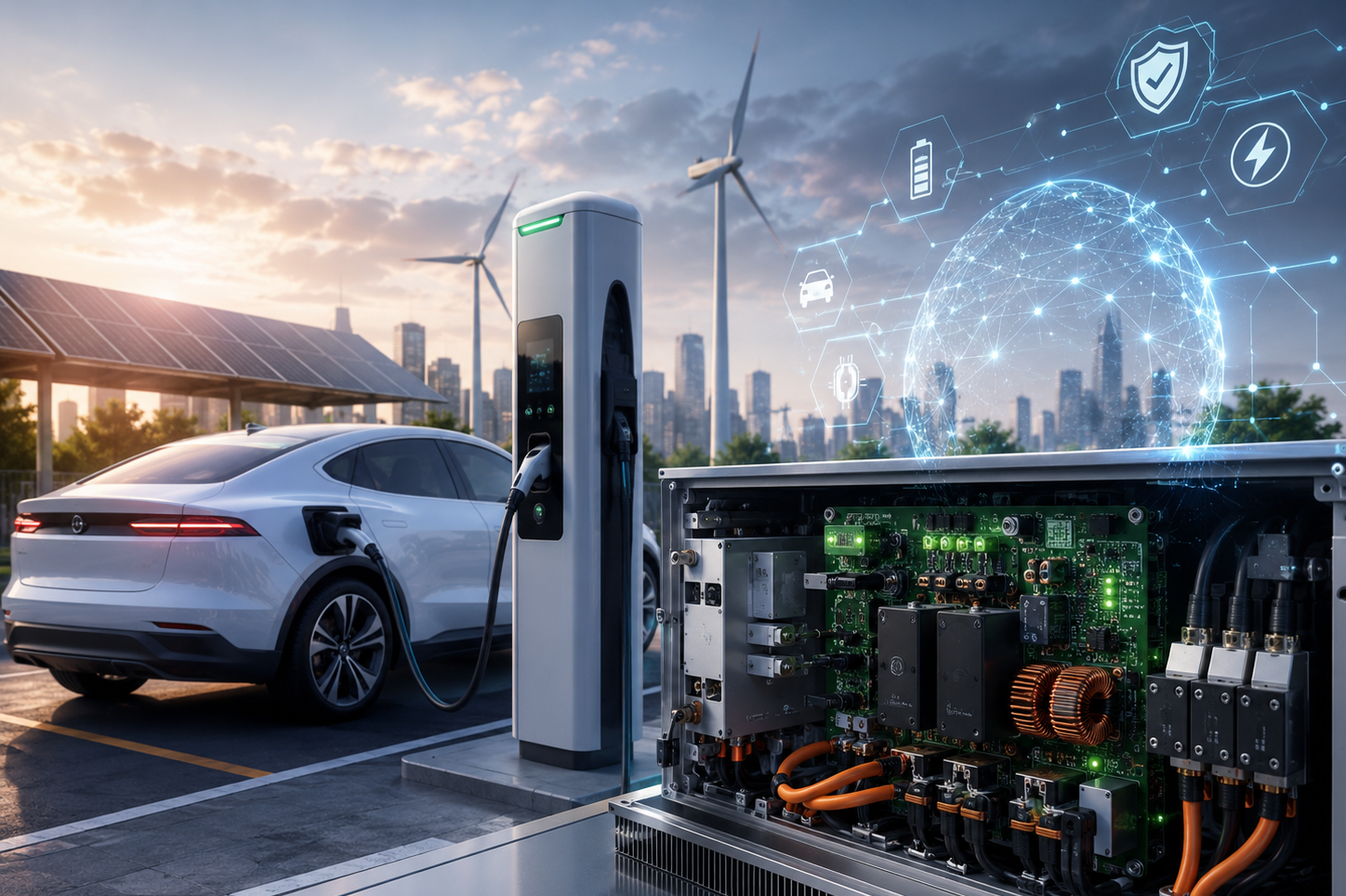
As the electric vehicle (EV) market and the demand for high-speed charging continue to grow, the EV charger power supply industry is facing stricter safety, energy efficiency, and technical specifications. Starting in 2026, relevant mandatory certifications and standards in China will be implemented successively. Among them, the China Compulsory Certificate (CCC) applies to newly manufactured EV chargers starting August 1, 2026, requiring core components such as power modules and main control boards to possess corresponding testing and certification data. Additionally, the GB 46519-2025 EV charger energy efficiency standard is scheduled for official implementation on November 1, 2026. It will establish energy efficiency ratings based on charging conversion efficiency, standby power consumption, and sleep power consumption to further improve the energy utilization efficiency of charging equipment.
Regarding power module technology, NB/T 11864-2025 establishes comprehensive requirements for the electrical performance and reliability of charging modules, covering air-cooled, liquid-cooled, and various architected modules. It demands support for constant current (CC), constant voltage (CV), and constant power (CP) charging modes, while specifying standards for wide output voltage ranges, voltage and current regulation accuracy, output ripple, multi-module parallel current sharing, power factor (PF), total harmonic distortion (THD), and dynamic response. For high-power charging equipment with multiple parallel modules, current-sharing capabilities and fault management directly impact system stability and lifespan.
Safety and environmental adaptability are equally critical considerations in EV charger power supply design. Power modules must feature protection functions against overvoltage, undervoltage, overcurrent, short circuits, overtemperature, phase loss, and power surges. Liquid-cooled modules require additional precautions for coolant leakage and temperature anomalies. Outdoor equipment must also demonstrate strong endurance against high/low temperatures, damp heat, vibration, impact, and salt spray. Furthermore, with enhanced Electromagnetic Compatibility (EMC) requirements under standards such as GB/T 18487.2-2026, tests for conducted/radiated interference, electrostatic discharge, surges, and immunity are becoming increasingly essential. Power component selection, PCB power loop layout, common-mode filtering, and snubber circuit design within the power module will all influence the overall EMC performance of the charging equipment.
In terms of market and technical developments, 400V and 800V EV platforms alongside ultra-fast charging demands continue to propel EV chargers toward higher voltage, higher power, and higher efficiency. Some high-power charging modules are already designed for output voltages of 1000V or even 1500V. Wide-bandgap power devices such as Silicon Carbide (SiC), known for low power loss and high-frequency switching capabilities, help elevate energy conversion efficiency, lower thermal management demands, and reduce overall operating costs; consequently, their application in next-generation ultra-fast charging equipment is receiving significant attention. Moving forward, beyond pursuing higher output power, EV charger power supply products will place greater emphasis on energy efficiency, EMC, safety protection, module interchangeability, and long-term operational reliability—driving the charging infrastructure industry toward high efficiency, high reliability, and enhanced safety.
**Information Reference: [Dianyuan.com] https://www.dianyuan.com/bbs/2789626.html
**Note: This content has been compiled and adapted. For the full original text, please visit the link above.