【Technical Column】How to Effectively Control Electromagnetic Interference (EMI) in Power Transformers?
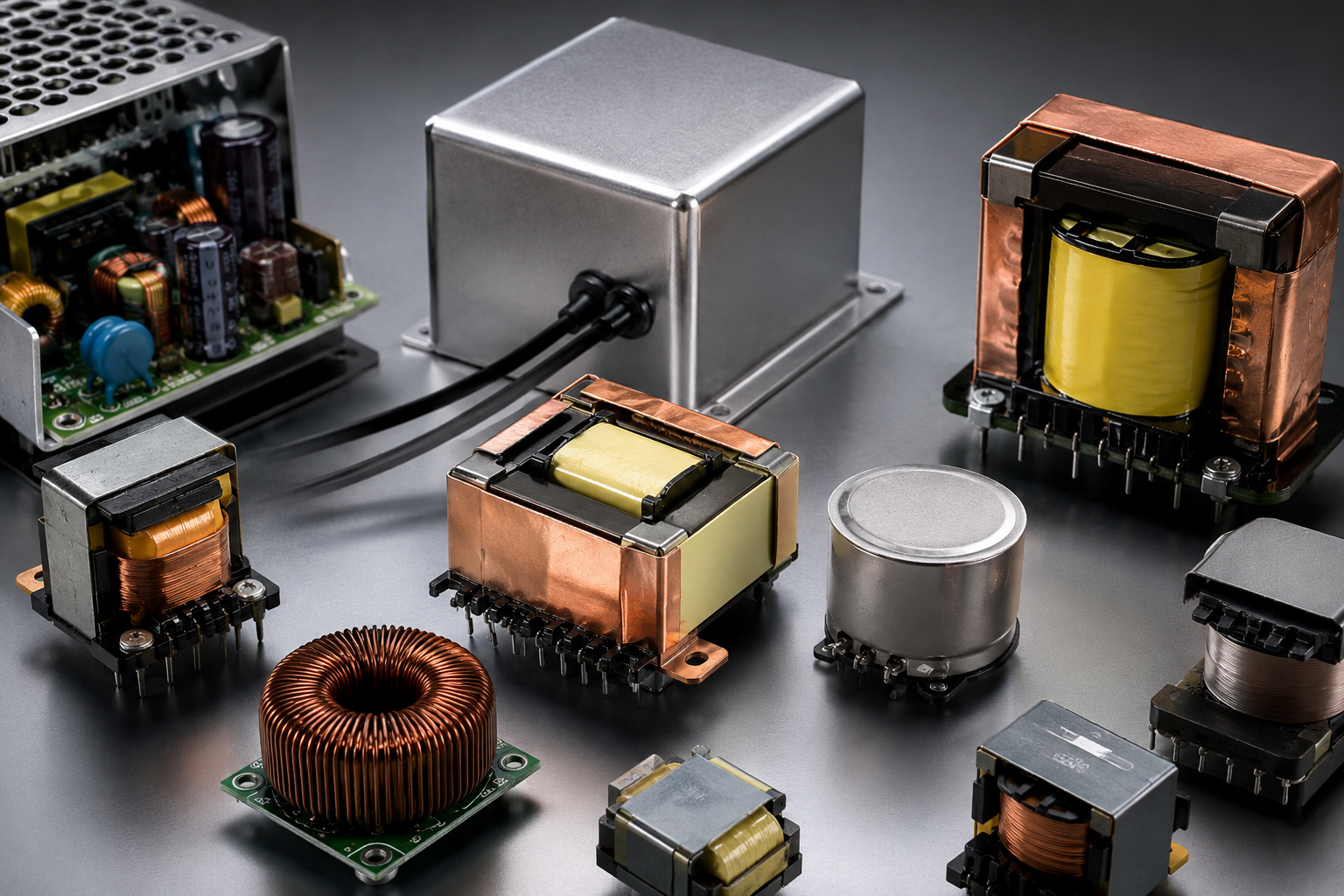
In modern electronic and power system design, power transformers are essential components for providing stable power and enabling energy conversion. However, they are also among the common sources of electromagnetic interference (EMI). During transformer operation, electromagnetic energy generated by the transformer can easily interfere with nearby sensitive electronic components if it is not properly controlled, potentially resulting in system malfunctions or even equipment failure. The level of EMI generated by a transformer is primarily influenced by its magnetic characteristics, physical dimensions, number of winding turns, applied voltage and current, core type, and layout position within the circuit. These disturbances mainly propagate through common-mode (CM) electrical noise and electromagnetic radiation. Therefore, suppressing EMI at the source during the design stage is essential for improving the electromagnetic compatibility (EMC) of the overall product.
To address common-mode noise, safety isolation transformers typically employ multiple layers of thin-film insulation materials between the primary and secondary windings. In a coaxial winding structure, engineers may wrap a layer of copper foil around the input winding to form a Faraday shield. This shield directs noise currents generated by the interwinding capacitance to the input ground, preventing them from crossing the isolation barrier and coupling into the secondary winding and downstream system. Similarly, adding a second Faraday shield around the output winding and connecting it to the output ground can further block reverse capacitive coupling from the output side to the input side. It is important to note that an improperly designed shield may act as an antenna and pick up interference from other sources. Therefore, the shield should be connected to the non-driven side of the winding and then connected to the corresponding ground point to achieve optimal isolation performance.
In addition to electric-field shielding, protection against magnetic-field interference is equally important. In many cost-sensitive transformer designs, a thin copper strip, commonly referred to as a Flux Band, is wrapped around the outside of the transformer to provide radiation shielding by reducing the effects of eddy currents. Whether the Flux Band is left floating or connected to output ground, it can provide effective attenuation of electromagnetic interference. In extreme applications where EMI levels are particularly severe, a fully enclosed magnetic shielding enclosure may be considered to directly contain stray magnetic flux and electromagnetic radiation within the shielding structure and provide a path toward the ground layer. However, because a magnetic shielding enclosure can significantly increase product cost, weight, and manufacturing complexity, it is generally recommended as a last resort.
Finally, optimizing the core structure and winding parameters is another important strategy for reducing EMI at its source. Selecting a core with a larger cross-sectional area or increasing the number of winding turns can effectively reduce the transformer's operating magnetic flux density, thereby reducing the intensity of the generated electromagnetic field. In terms of core selection, traditional linear transformers using EI laminated cores tend to generate relatively higher levels of EMI, while toroidal (Toroid) cores, with their more enclosed magnetic paths, can significantly reduce interference. For high-frequency transformer applications, E-type cores and their derivatives feature relatively open structures and therefore cannot completely contain the electromagnetic field, resulting in comparatively higher interference. In contrast, pot cores and toroidal cores, with structures that are nearly fully enclosed, can more effectively confine the electromagnetic field within the core, making them excellent choices for minimizing electromagnetic radiation and EMI propagation.
**Read the full technical information from https://www.big-bit.com/wap/news/405782.html
**Note: This content has been compiled and adapted. For the full original text, please visit the link above.