Market Insights: The Evolution and Growth of Current Sensors in China
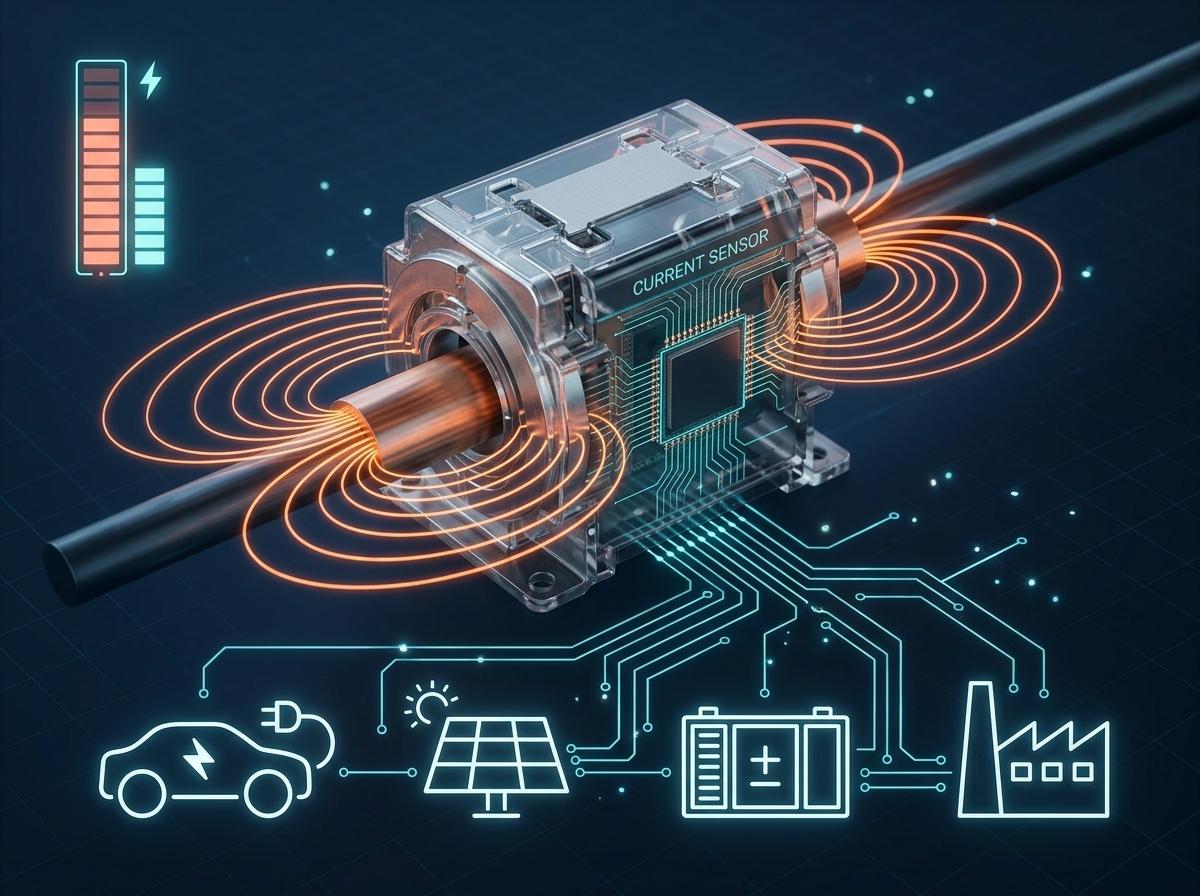
Driven by the global transition toward clean energy and accelerated industrial automation, China's current sensor market is entering a major transformation phase fueled by electric vehicles, photovoltaics, energy storage, and the demand for high-voltage, high-precision solutions. The market for magnetic current sensors alone is projected to grow from $280.2 million in 2025 to $562.7 million by 2030, representing a compound annual growth rate (CAGR) of 15.0%. As critical components for power conversion and system protection, current sensors are seeing rapidly expanding downstream demand. In 2025, China recorded 16.49 million new energy vehicle (NEV) sales (up 28.2% year-over-year), 1.2 billion kW in cumulative solar PV capacity (up 35.4%), 136 million kW in new energy storage capacity (up 84%), and an output of 773,000 industrial robot units (up 28%). These robust sectors are directly driving demand for advanced current sensing across main traction inverters, battery management systems (BMS), solar inverters, and servo drives.
On the technical front, traditional open-loop and closed-loop Hall-effect architectures continue to dominate mass-market applications due to their maturity and cost-effectiveness. However, as 800V EV architectures gain traction and solar/storage DC bus voltages escalate to 1500V and even 2000V, integrated Hall-effect ICs—which combine conductors and signal conditioning into a single package—are gaining rapid adoption in low-to-medium current applications. For premium automotive, energy storage, and high-precision motion control applications, magnetoresistive technologies (such as TMR and AMR) offer higher sensitivity and lower noise. Meanwhile, fluxgate sensors and shunt resistor solutions combined with isolated amplifiers remain indispensable in ultra-high-precision and high-current domains, respectively.
Looking ahead from 2026 to 2030, the current sensor industry is shifting toward higher component integration, elevated voltage isolation, and superior full-temperature accuracy. With growing demands for functional safety, automotive qualifications (such as AEC-Q100 and ISO 26262), and built-in diagnostic capabilities, current sensors are evolving from simple analog measurement devices into intelligent, self-diagnosing nodes. Overall, competitive dynamics in the market are moving away from pure price competition toward a comprehensive evaluation of accuracy, isolation rating, automotive reliability, and localized engineering support, opening significant opportunities for companies with strong technical capabilities and supply chain resilience.
**Information Reference:
【MarketsandMarkets】https://www.marketsandmarkets.com/Market-Reports/geography/magnetic-current-sensor-market/china
【Decision Advisors】https://www.decisionsadvisors.com/insights/china-current-sensor-market
【CIF.MOFCOM.GOV.CN】https://cif.mofcom.gov.cn/cif/html/mobile_data/market/sell/qcxsqk/2026/1/1768439584405.html
【 National Energy Administration】https://www.nea.gov.cn/20260129/6874f211acd0417eab7ac10c3061a7c2/c.html
【 National Bureau of Statistics】https://www.stats.gov.cn/sj/sjjd/202606/t20260604_1963888.html
【NOVOSENSE】https://static.cninfo.com.cn/finalpage/2026-03-31/1225059424.PDF
**Note: This content has been compiled and adapted. For the full original text, please visit the link above.